Hello everyone, my name is Derek. I live on a small farm outside of Louisville, Kentucky. As a child I always loved the smell of honeysuckle in the spring. It wasn't until I grew older that I came to realize that even though I loved this plant, it was seriously harming the native flora. Even after I had learned the affects of this sweet smelling invasive species I didn't do anything about it until this year when I finally
saw what it was doing to the environment.
.
 |
| My dog Dotty |
I had taken my dogs for a walk down to my uncle's house, and I saw he had trimmed several branches from honeysuckle bushes that had grown out into the road. When I looked at the ground underneath them I saw it was barren except for a few small honeysuckle plants that had sprouted. When I returned home I looked at a stand of walnut trees that grow in my yard. I knew a bush had popped up there, and when I inspected it I saw the same thing. A ring of barren dirt all around the plant.
 |
| My dog KoKo |
It was right then that I decided to start my war on this plant. I found a hatchet my father had given me years ago, and went to work on that plant. It took me about 20 minutes to hack the whole thing down. I followed that up by chopping down 4 more bushes that day. After that I was completely worn out. With all the bushes that were around I would
never be able to kill them out before new ones grew.
I then went to find a saw. The saw worked somewhat faster, but was still to slow. I went to a garden supply store, and bought some big clippers. They worked OK for a while until I tried to cut a branch and the blade snapped off. I took that pair back to the store, and bought another pair. This time I bought a pair of
Fiskars powergear clippers . So far they have worked great. I have cut hundreds of thick branches so far, the blade has bent a tiny bit at the top, but I am still happy with the results.
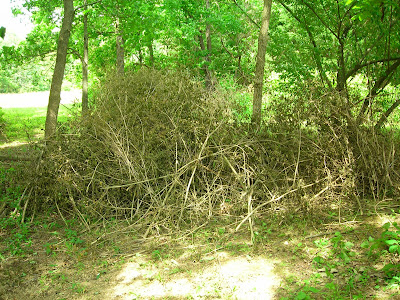 |
| A small pile of cut honeysuckle. |
Cutting down all this honeysuckle left me with two different problems. The first problem was that I had tons of honeysuckle limbs lying around. I was discussing this with my father, and he said we had an old small wood chipper in a barn that my grandfather purchased years ago. I hope to try chipping them up, and using it as mulch for my garden. In my research into honeysuckle I read they produce an herbicide that helps kill other plants. I don't know if that will still be an issue when they are chipped down, but I guess it will be a good experiment to try.
The second problem had to do with my chickens. I usually keep about 20 chickens that I let free range on the farm. As I was cutting down bushes I noticed that most of the places they like to hide during the day are under honeysuckle. I need to find some other kind of bush to plant that the can hide under. I have a lilac bush they also enjoy laying in, but lilac requires full sun so I am not
confident I can plant it in all the places I have cut out honeysuckle.
If anyone has any ideas on other bushes I can plant in zone 6b, hopefully some that
are also native to Kentucky, that info would be much appreciated.
Read more here: http://www.kentucky.com/2010/03/21/1191325/battling-a-plant-trying-to-take.html#storylink=cpy
 We have a few honey locust trees down on the farm. My father says there used to be more of them, but when I was very small something killed most of them off. They are a pretty tree, but they have some really wicked thorns on them. The tree does not get its name from being a good
honey plant. It is given the name because of the sweet taste of its seed
pods.


